
 English
 Français
Listen closely: A quiet, supersonic jet capable of blasting through the sound barrier without emitting a sonic boom could pass over your home as soon as 2022. A decade later, you might even be able to ride in one.
NASA and Lockheed Martin Aeronautics Co. are working together to build an experimental plane (or "X-plane") called the Low-Boom Flight Demonstration (LBFD), which will reduce the sonic boom synonymous with high-speed flight to "a gentle thump," NASA representatives said at a news conference today (April 3).
The agency has awarded Lockheed Martin a $247.5 million contract to construct a working version of the sleek, single-pilot plane by summer 2021 and should begin testing over the following years to determine whether the design could eventually be adapted to commercial aircraft. [Supersonic! The 11 Fastest Military Planes]
"I believe today is a new beginning for NASA aeronautics," Jaiwon Shin, associate administrator of NASA's Aeronautics Research Mission Directorate, said at the news conference. "Our long tradition of solving the technical barriers of supersonic flight to benefit everyone continues."
NASA and its partners in the aviation industry are building "low-boom aircraft," with different designs than those used in older supersonic jets, like the retired Concorde. The new generation of planeswill have a body shape that reduces the "annoying noise, rattle and vibration" that occurs when aircraft break the sound barrier, creating the shock waves that produce sonic booms, NASA said.
The X-plane will be about the length of an NBA basketball court, will fit a single pilot and will fly at about 940 mph (1,510 km/h) at an altitude of 55,000 feet (16,800 meters). If all goes according to plan, spectators on the ground should barely be able to hear the plane as it rips through the sound barrier high overhead. (The speed of sound, also known as Mach 1, varies depending on air pressure and temperature but is roughly measured at about 758 mph or 1,220 km/h.)
The startlingly loud booms that supersonic planes create led the U.S. Federal Aviation Administration (FAA), in 1973, to ban these aircraft from flying over land. But NASA is working with the FAA, as well as other aviation organizations, to change these regulations, Alexandra Loubeau, an acoustics engineer at NASA's Langley Research Center in Hampton, Virginia, said in statement.
"We are working with other agencies across the world to support development of new noise-certification for supersonic flight, so, instead of being prohibited, it would be allowed over land and sea," Loubeau said.
But before commercial flights start traveling at supersonic speeds, NASA has to figure out why the noise these planes generate is so annoying to people on the ground. Is it the "boom" noise itself that bugs people, or is it the vibration that accompanies the noise? The agency has developed a series of tests at its research facility to answer these and other questions.
"What we do in these tests is we break apart all the different parts of a sonic boom — the sound, the vibration it may cause, the rattling of objects inside a room that the vibration may cause," said Jonathan Rathsam, a NASA acoustics engineer. "We break those all apart and try to add them in piece by piece to try to figure out what is driving the annoyance."
For the tests, NASA recruits members of the local community from near the agency's research facility in Virginia. The volunteers sit in an enclosed room and are subjected to a series of sonic-boomlike sounds generated by powerful speakers and subwoofers. The chairs the participants sit on are also equipped with shaking devices that rattle to mimic the vibrations from a real sonic boom.
The booms simulated in NASA's lab aren't quite as loud as those produced by first-generation supersonic planes like the Concorde, which stopped service in 2003. Instead, the researchers are testing sounds and vibrations that mimic the softer booms (NASA calls them "thuds") that next-generation supersonic aircraft could generate.
"The data in this lab will be used to develop a model to predict people's response to sonic booms, but then that is only one piece of the big puzzle," Loubeau said in a statement. Field studies are also being conducted in which supersonic planes fly over people's actual homes to assess the real-life annoyances caused by sonic booms, she added.
But don't expect to see supersonic planes flying over your neighborhood just yet. Loubeau said the first of these high-tech (but low-decibel) aircraft won't take to the skies until 2025.
CLICK THE LINK BELOW TO WATCH VIDEO ABOUT NASA SUPER SONIC JET
https://youtu.be/3Fyd_YDAJNg
(Marlon Deinmodei)
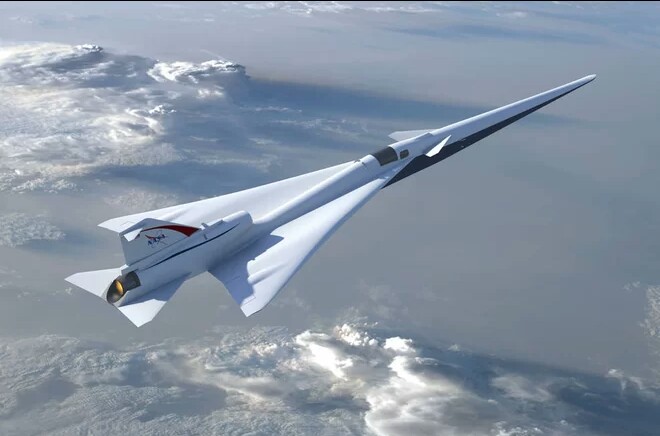
Supersonic X-Plane Will Tear Through the Sound Barrier with 'a Gentle Thump'
- marlon111d's blog
- Log in to post comments